Hello! As a disclaimer, I’m a complete beginner when it comes to this. I am trying to achieve closed loop velocity control of a 3 phase BLDC motor with a 3 channel hall sensor, and to that end I am using a nucleo 64 board and a SimpleFOC Drive v1.3 driver.
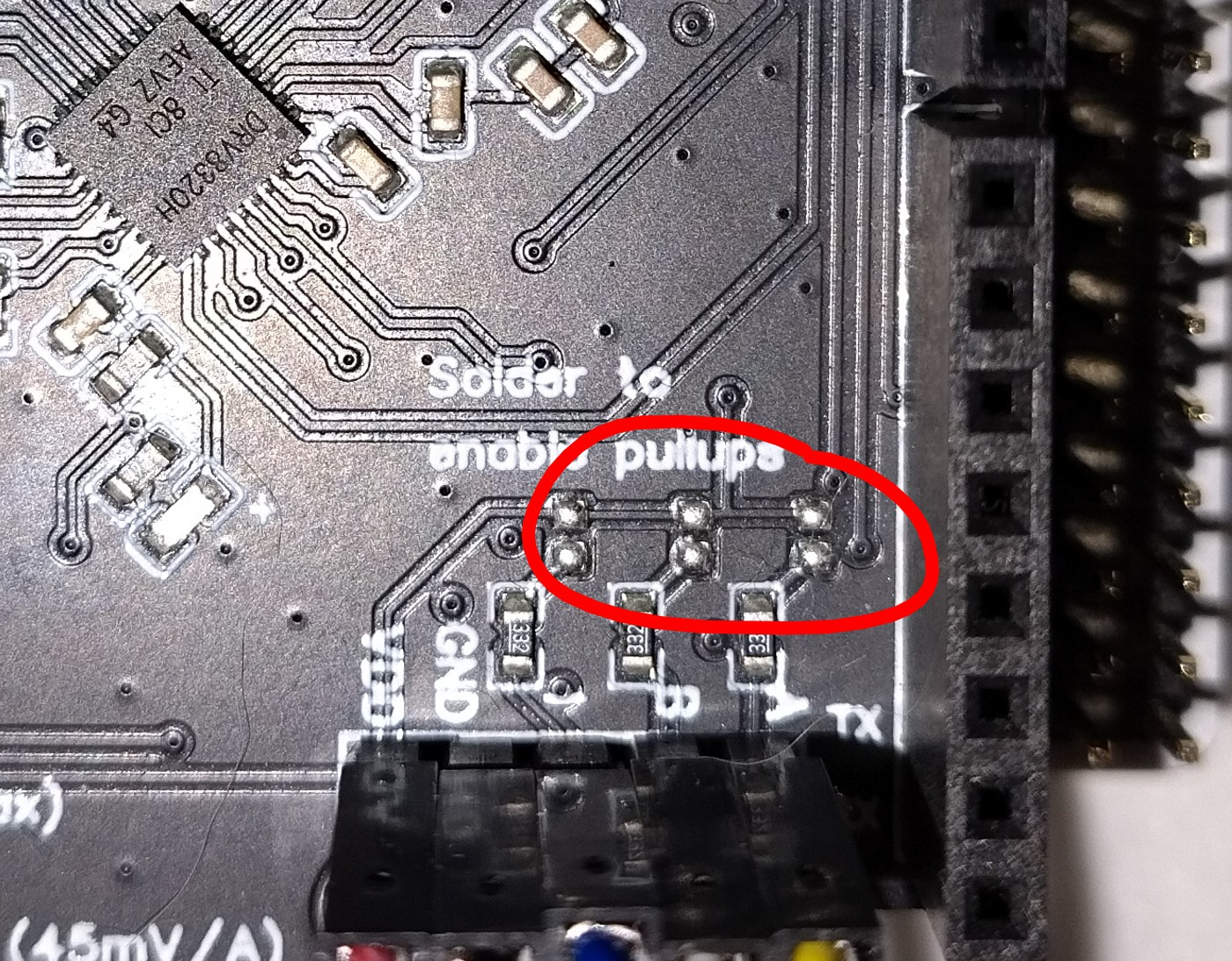
My main question is about the SimpleFOC Drive’s soldering pads, as I know the SimpleFOC Shields have pads that need to be soldered for them to work. I was unable to find the relevant information on the github. As I want to use the hall sensor pullups, would I just need to solder each of the pairs of pads above the pullups for them to work? Are there any other pads I should solder?
I just want to make sure of what I need to do before trying anything and potentially ruining the driver.
Thank you in advance for all the help, any extra tips when it comes to using this board is appreciated 
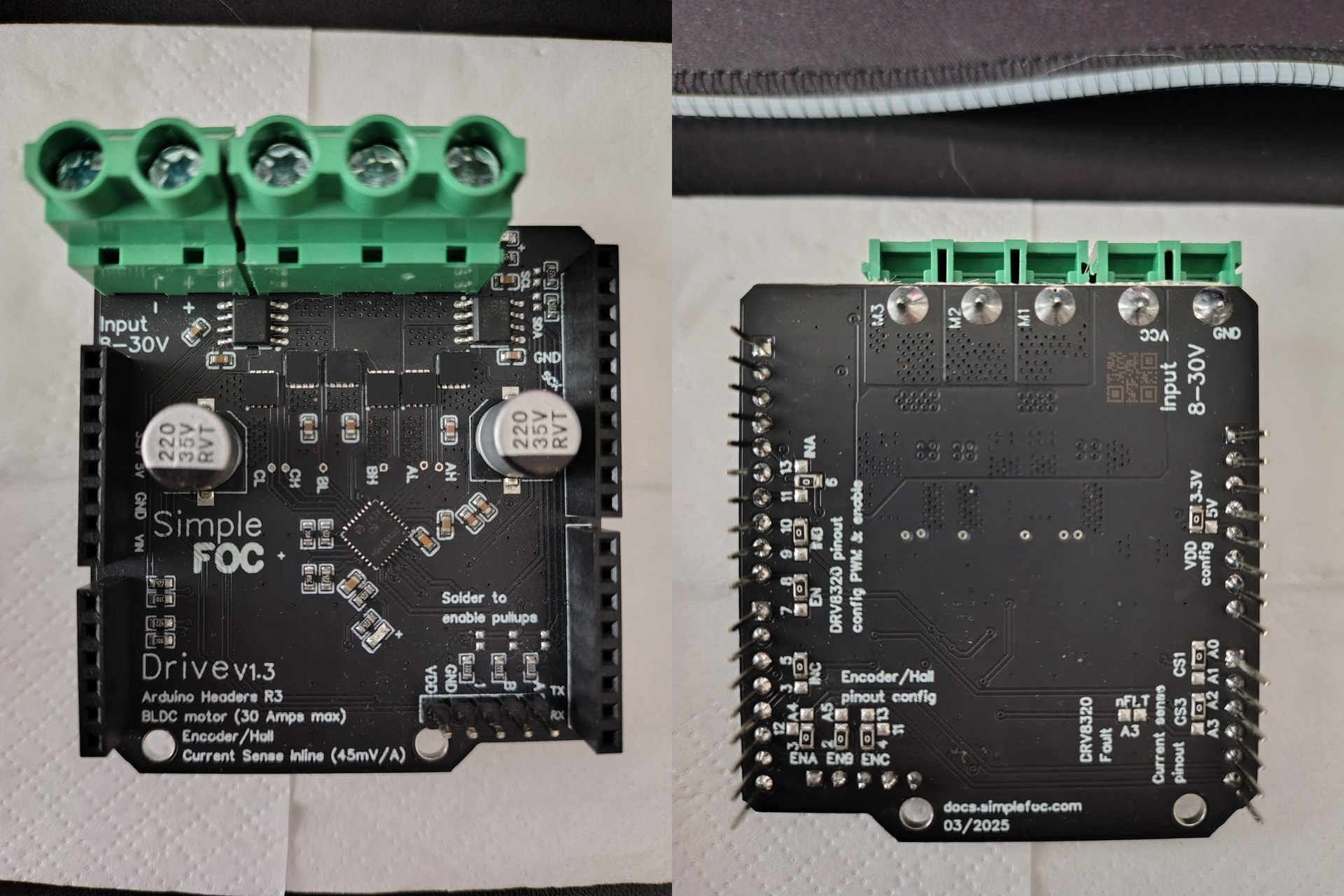
Pictures of the board:
10 Answers
10
Hi there!
Nice, we did not have the DriveShield from makerbase on the forum yet. I’m very much interested in any feedback you might have!
We are working on making them available on our side too. 
So the board has basically the same soldering scheme as the SimpleFOCShield, however Makerbase boards seem to come with the 0Ohm (short circuit) resistor presoldered so you don’t have to solder anything to get started.
Your pin-out (assuming you have the board on the picture) is:
// pins 6, 10, 5,  and enable is on 8
BLDCDriver3PWM driver = BLDCDriver3PWM(D6, D10, D5, D8);
For current sesning you can use:
// inline current sensor instance
// ACS712-30B
//   - amp gain in 66mA/V
// but there is a voltage divider 3.3/5.0 volts
//    - 4.7k and 10k -> (10/14.7) = 0.68
InlineCurrentSense current_sense = InlineCurrentSense(0.68*66.0f, A0, A2);
And if you’re using some stm32 chip I’d suggest to use low-side current sensing which is not blocking and has much better performance
LowsideCurrentSense current_sense = LowsideCurrentSense(0.68*66.0f, A0, A2);
We will be pushing the docs on this board in the coming months. Sorry about the lacking docs at the moment.
Thank you for the information!
I’ve done a few tests for my application and the board seems to be working great.
Thanks again for the help and tips!
@Antun_Skuric
“LowsideCurrentSense current_sense = LowsideCurrentSense(0.68*66.0f, A0, A2);”
ChatGPT said it should be 0.066f for the current gain? Is that correct?
Hey Olaf!
It’s 0.68 (3.3/5) times the millivolts per amp gain (66).
So it’s 0.68*66. We decided to have the constructor in MV per amps and NOT volts per amp.
We have two constructors. One uses m per amps gain (better for hall current sensors) and the other that takes in the shunt resistance(ohms) and the amp gain (volts per volt)
Thanks, it shows we can’t fully trust AI yet.
For the upcoming documentation I could add a nice summary for the “IDrive” and “VDS” solderpads.
I couldn’t find anything in the docs, so I asked ChatGPT. The answer is in German and I can’t upload .txt files.
Should I quote it here?
@Antun_Skuric
Sorry to bother you again, but I just wanted to make sure what the pins for the hall sensors would be on the board.
From the way the board is set up, I assume they should be Channel A-> D3, Channel B->D2, Channel C->D4.
Is this correct? Thank you in advance for the help 
Edit: I am also wondering whether it is needed to solder the jumpers above the Hall pins, as while testing I seem to be unable to read the sensor’s output (picture attached)
It certainly looks like you need to solder them. Digital halls typically need 5V power, so I’d assume that VDD line is 5V, so make sure the STM32 pins reading them are 5V tolerant. If not, the sensor outputs are open-drain so can be pulled up to 3.3V instead. You could either solder fine wires to the resistor side of each of those jumpers, or ignore those resistors and solder some regular peanut resistors to the wires.
there is another solder jumper set for VDD= 3.3 or 5V, I guess for most MCU boards 3.3v is correct.
The 8bit UNO might be the exception, but with commander enabled, it doesn’t have enough flash-RAM anyways…
Anyways, I interpreted the ABI pin names as pullups for encoder not for hall sensors?
They would only work with NPN hall sensors, so better check the datasheet of the sensor
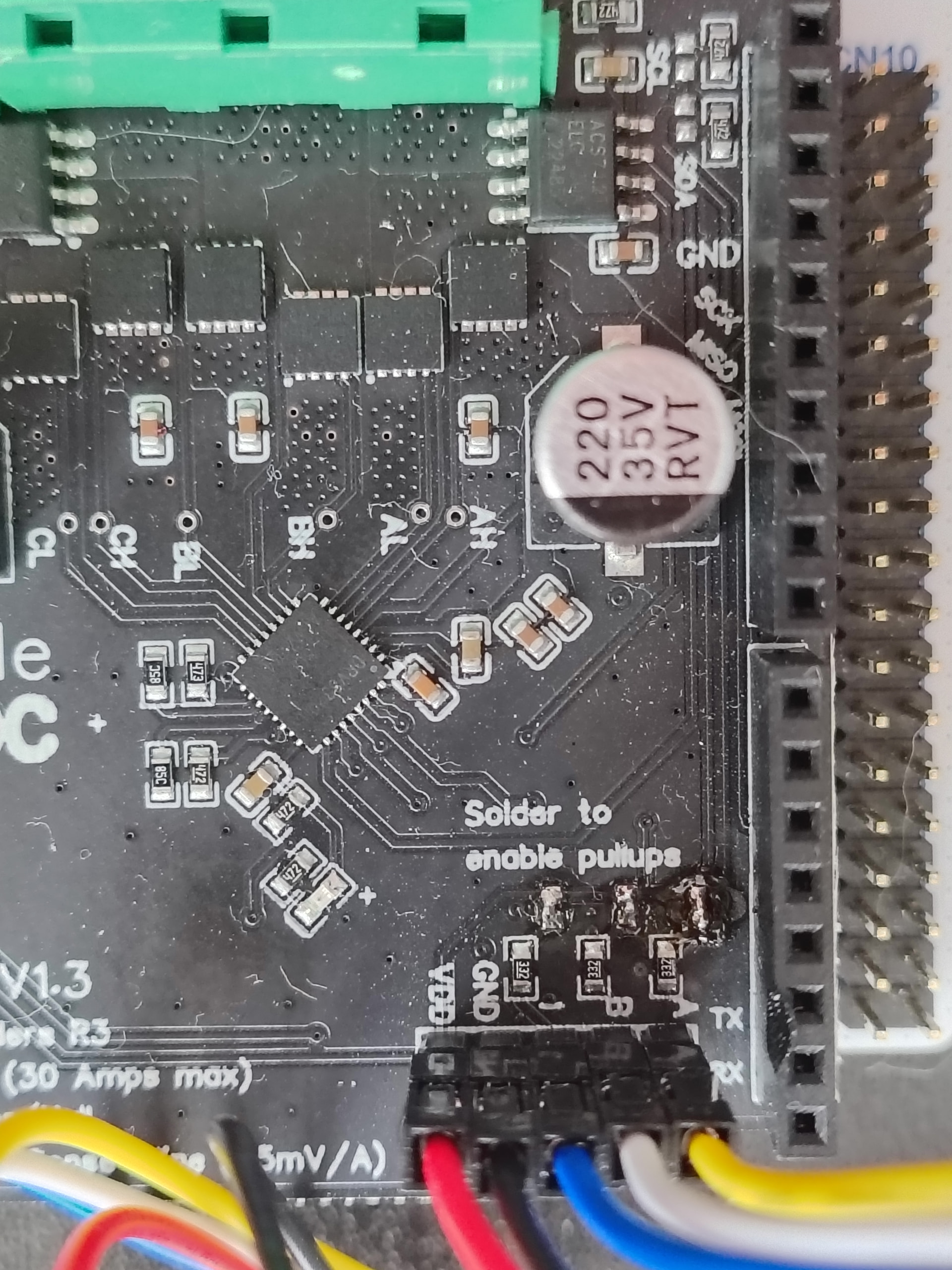
I soldered the pads above the hall sensor pins, however I ran into a bit of a problem due to my (cheap and non adjustable) soldering iron, which got too hot and it seems like it slightly melted the board around the channel A pad (pic attached). Is this damage sever enough to compromise the board?
Impossible for any of us to tell, especially since the picture doesn’t make what damage is present very clear. You can use a multimeter to check continuity is where it should be using diode mode.
Funny coincident... I was absent from simplefOC for about 2 years and was now looking for info about the predecessor V1.2 (Antun was very generous to send me some preproduction samples, but I haven't had a good use for them until now. ) As it seems, there are some differences (errors?) in the silkscreen of V1.2 , am I right? Are there other significant issues I should know, before powering them up? THX Olaf
– o_lampe