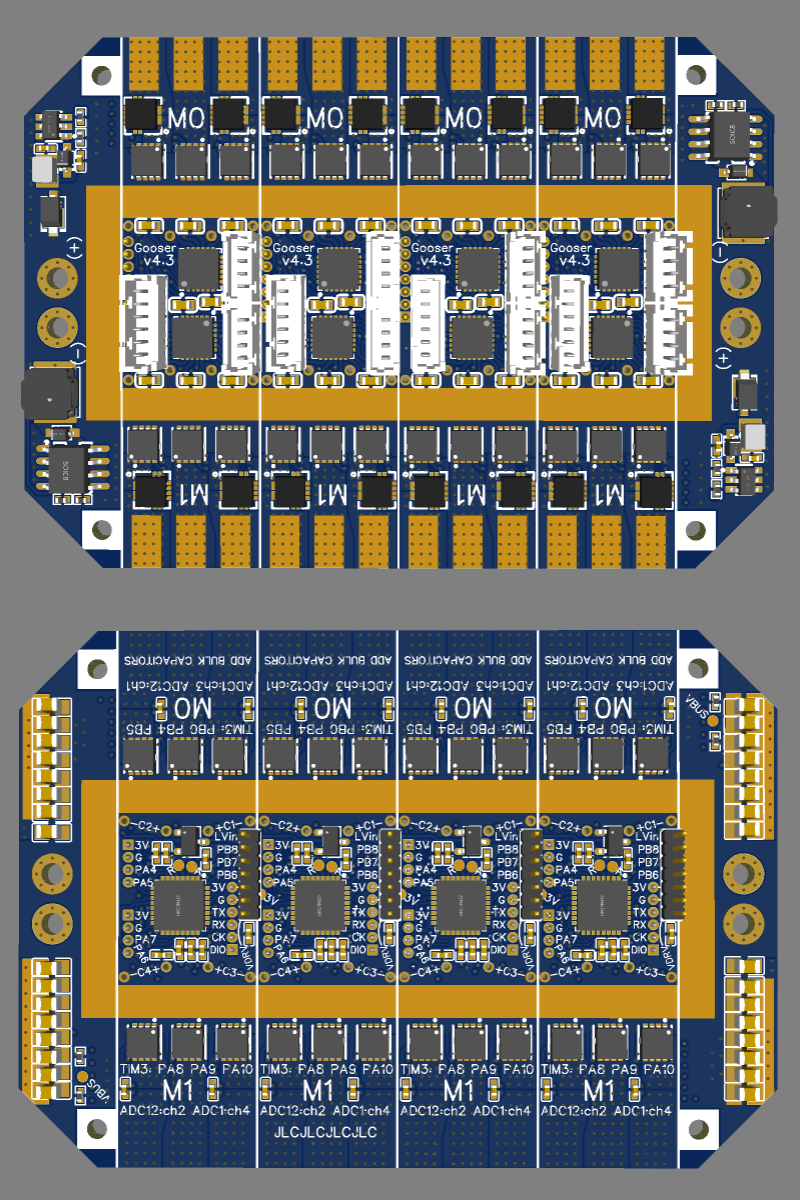
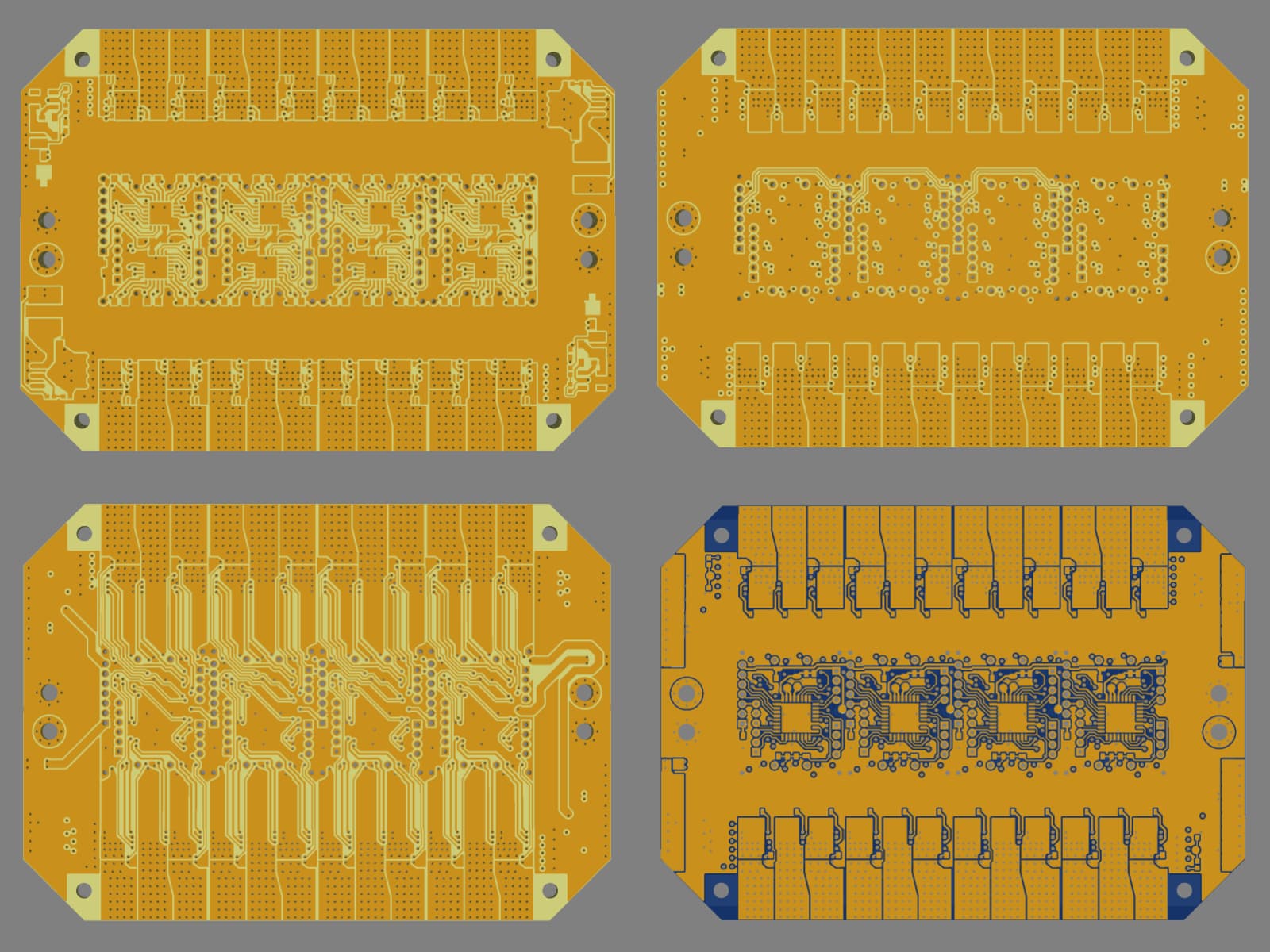
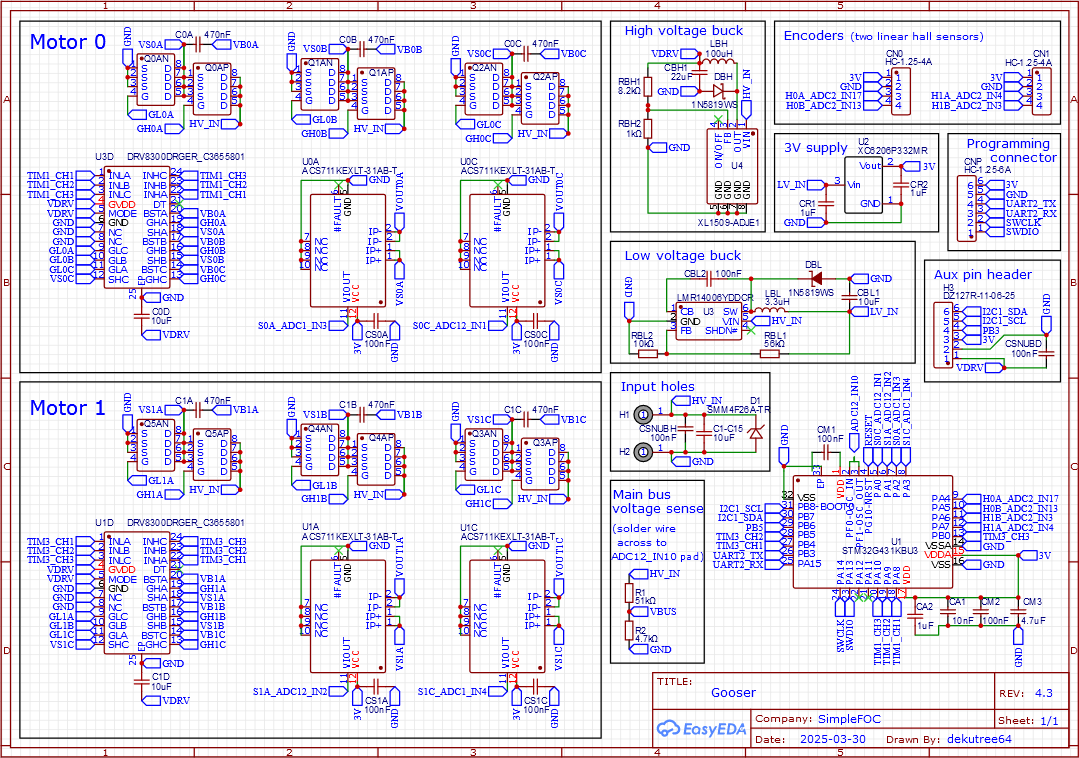
Finally placed the JLC order after making a bunch more edits.
- Changed net names on each copy of the 14mm section so I can run DRC on the 8-motor version without getting a ton of errors.
- Discovered that at some point early on I moved the left side pin header down by 0.1mm but forgot to move the right side one to match, so the holes were slightly off when copy-pasted, putting them too close to some traces and vias.
- Added thermal reliefs on the connector ground pins. I don’t like setting the copper area to spoke mode because I do want the capacitors to have maximum conductivity even if they are a little tougher to solder, but there’s no need to suffer on the connectors. To solve it, I temporarily change the pad net names when rebuilding the copper areas to leave a clear space around them, and added traces to cross the gap.
- Added a voltage divider on the back for the main bus voltage. It’s not connected to anything, but can be wired over to the ADC12_IN10 pad to allow voltage monitoring.
- Copied input area onto the right side of the board, so when cutting them in half I’ll get two full-featured ones. This involved removing the extra pin header from the right side to avoid pinching the input rail width, but I had no particular plan to use it anyway.
- Extended motor wire pads by 2mm, similar to how I did on past versions. They’re easy to sand off if desired, or can be cut off before manufacturing by moving the board outline. This allows using two 14mm long capacitors per motor and bending them down to lay over the mosfets. Previously there was just barely enough room, but would have been difficult to get the tip of the soldering iron on the pad without touching the capacitor.
- A few minor grounding improvements.
- Added timer/current sense information to the silkscreen.
I got a stencil this time, after finding that you can specify a size smaller than the full sheet, and if <200x200mm, the added shipping cost was only $4. Though the stencil itself was still rather pricey at $14 with the recommended electropolishing option for 0.5mm pitch.
Now I just have to make up my mind what all components to buy and how many motors worth…