Hello, I am currently working on a project where I constantly need to rapidly accelerate or decelerate to create a Persistence of Vision Illusion. The Motor needs to oscillate between two different angles. I have already looked at this post about the addition of an External Break Resistor: External Brake resistor , but I am not quite sure what to do. The total Inertia is about 30 *g**cm^2, which gets accelerated to 2000 rev/min and then decelerated as fast as possible. This isn’t much kinetic Energy that the psu would need to handle, but I am concerned about the frequency of this happening leading to problems. My current Motor is a 42BLF01, the Driver is a DRV8302 Board and for the mcu I am using a ESP32. Here are my Questions:
Should I even need to be concerned about this amount of breaking? If yes, what are the options available?
Are there other things that I should keep in mind with such a dynamic task?
braking is simply current being driven back to the supply.
if you use a lipo battery, you probably don’t need braking. it would just regen back to the battery. however, this will shift the battery voltage around, esp if long or thin wires are used between battery and the driver
other power supplies typically don’t have much ability at all to accept current into the supply.
a regen brake can be created without software.
a board has op amp, zener, etc to turn on a transistor when vbatt goes too high. problem can be that we want to set that limit close to because we want to limit voltage spikes.
another would be to put a current direction sensor in power in. when flowing backwards, regardless of amplitude, it will drain off the current which will bring the net c, urrent back to normal.
or, just use software to turn the brake on and off
you could do this with an opamp and power transistor in series with brake resistance so it will adjust the amount of load to balance against the braking current perfectly
Thanks for the detailed Answer! The wire between the battery and the driver shouldn’t be a problem since both will be in the same case.
Did i understand correctly, that both of your described ways are for use in combination with a battery?
I would like to avoid using a battery, since the device I am building will be connected to a power supply either way. Would these two options also work with a break resistor?
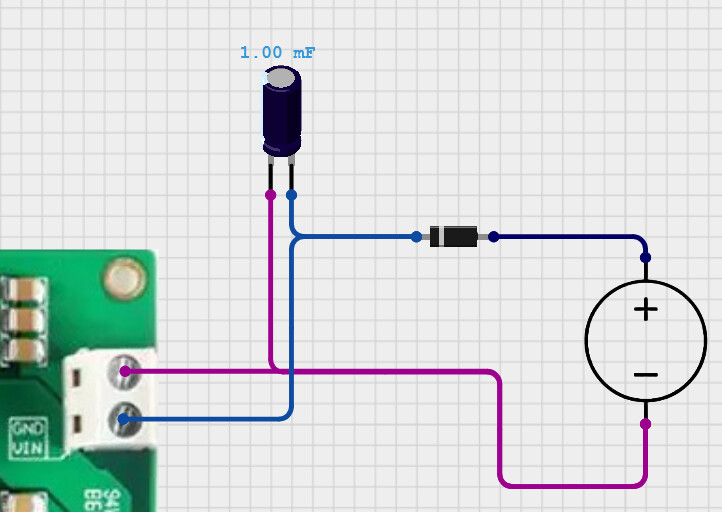
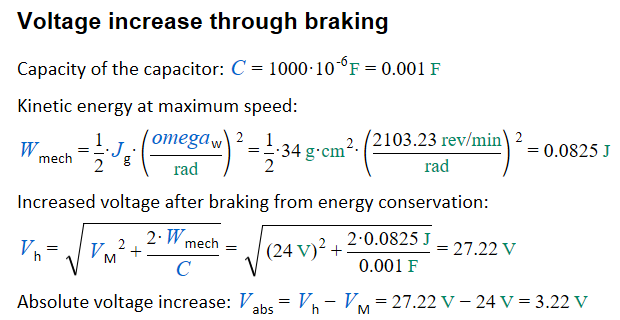
I have been thinking about this and I really would like to avoid using a separate Battery just to avoid breaking. But further search leads me to the conclusion, that a external Break Resistor may be too difficult to implement for me. So I came to a conclusion to stop the back flow with a diode and catch the Energy with a Capacitor, which would look like this:
I think this can work, but haven’t tried it myself. The reason people usually don’t do this is because the diode in the power path always will be burning power, you’ll have to choose one that can handle the maximum current you expect to handle and can thermally deal with the continuous currents you expect…
I think this can work, but haven’t tried it myself. The reason people usually don’t do this is because the diode in the power path always will be burning power, you’ll have to choose one that can handle the maximum current you expect to handle and can thermally deal with the continuous currents you expect…
– runger