### Author:  [@Candas1](https://community.simplefoc.com/u/Candas1)
#### Post date: [July 10, 2024, 6:31pm UTC](https://community.simplefoc.com/t/sensorless-bemf-reading-with-b-g431-esc1/5173/2 "2024-07-10T18:31:30Z")
It’s not using the BEMF sensing but maybe you can try the flux observer I ported as a [simplefoc sensor](https://github.com/Candas1/Arduino-FOC-drivers/blob/flux_observer/src/encoders/MXLEMMING_observer/README.md), I tested it on a hoverboard motor with [this](https://github.com/Candas1/SimpleFOC_b-g431b-esc1/tree/sensorless_observer) example project.
I am actually working on a unified current sense driver for stm32 that let’s you sample any other pin easily, it works but I still have a list of things to do there.
[Here](https://github.com/Candas1/Arduino-FOC/blob/3910a080c5eda1ddf90712ed665bedb0ba33473a/src/current_sense/hardware_specific/stm32/stm32_mcu.cpp#L159) you can see I added the BEMF pins already.
If I remember well you need to do this in the main loop to get the values:
> \_readADCVoltageLowSide(A\_BEMF1, currentSense-\>params);
But I haven’t tried to use it for sensorless, you should probably calibrate the 0 offset for each phase. I am not sure if this is meant for 6 step communation only, or you can do a clarke transform and use atan2 to get an angle.
---
### Author:  [@Copper280z](https://community.simplefoc.com/u/Copper280z)
#### Post date: [July 10, 2024, 10:51pm UTC](https://community.simplefoc.com/t/sensorless-bemf-reading-with-b-g431-esc1/5173/3 "2024-07-10T22:51:29Z")
> [@Candas1](#):
>
> But I haven’t tried to use it for sensorless, you should probably calibrate the 0 offset for each phase. I am not sure if this is meant for 6 step communation only, or you can do a clarke transform and use atan2 to get an angle.
That’s meant for 6 step, iirc. You only get an interesting value by reading the voltage of a phase when it’s half bridge is in high-z mode, otherwise it’ll just read psu voltage or ground.
---
### Author:  [@Candas1](https://community.simplefoc.com/u/Candas1)
#### Post date: [July 11, 2024, 4:35am UTC](https://community.simplefoc.com/t/sensorless-bemf-reading-with-b-g431-esc1/5173/4 "2024-07-11T04:35:49Z")
OK so other than 6 step it could be interesting for tracking when the motor is not driven only.
---
### Author:  [@arpakai](https://community.simplefoc.com/u/arpakai)
#### Post date: [March 23, 2025, 8:03pm UTC](https://community.simplefoc.com/t/sensorless-bemf-reading-with-b-g431-esc1/5173/5 "2025-03-23T20:03:38Z")
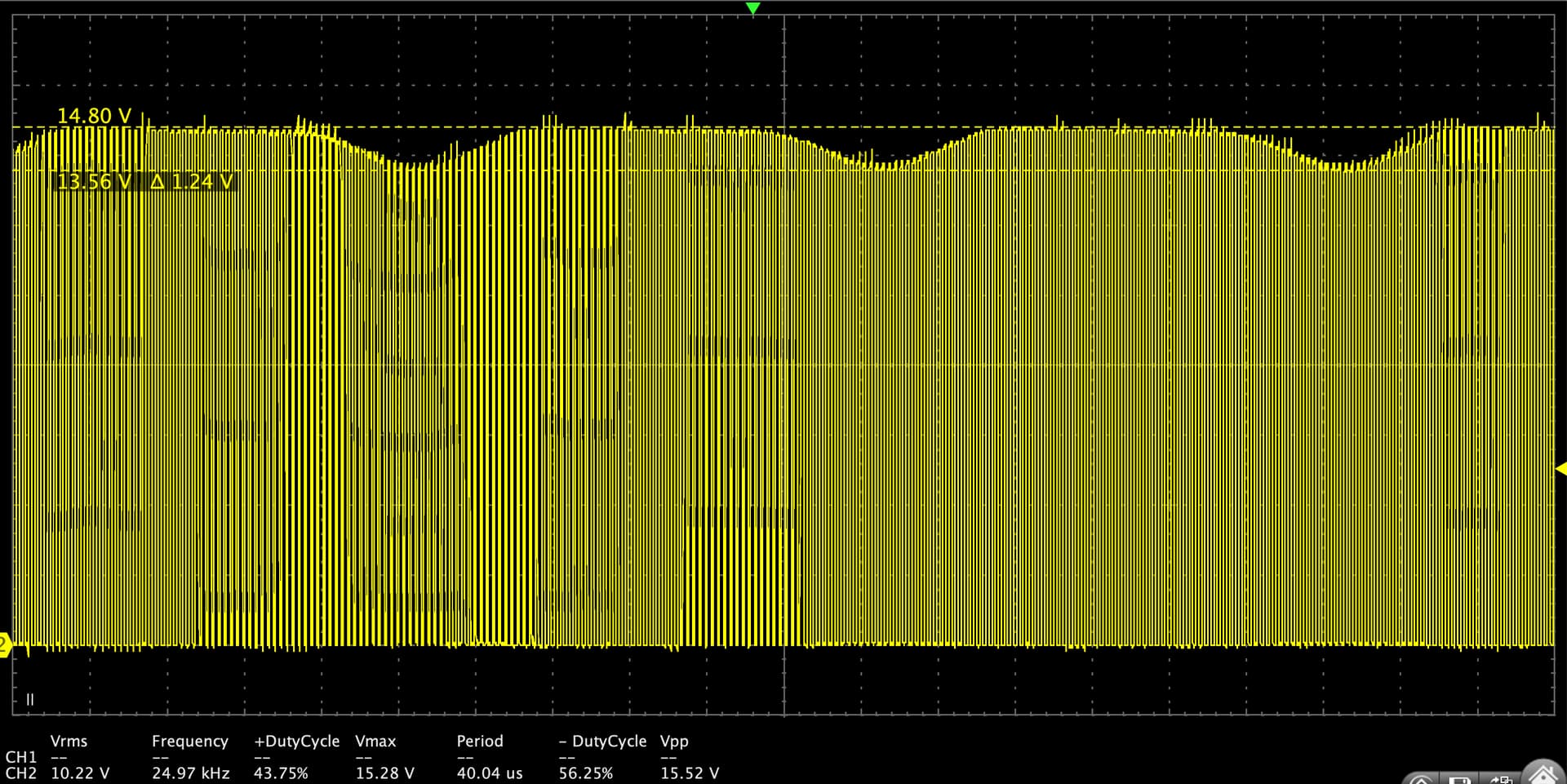
Hello sir, I was trying to use the code that you provided for my project. I have a B-G431-ESC1 and x2216-5 2400KV BLDC motor. I adapted it to my current motor, but motor did not spin. It just created sounds. I will provide the code and the images from my osilloscope. Could you help me about it? At least i expected it to spin, however it did not.
#include \
#include \
#include
#include “stm32g4xx\_hal.h”
//local variable definitions
float target = 0.0; // used to change currently tested variable
int spinIt = 1; // iterator for the startup
int spinItSpeed = 1500; // rate of the startup, higher = slower
float radPerSec = 0; // driver the motor speed
int mxRads = 0; // max motor speed
int outIt = 0; //used for communication rate iteration
BLDCMotor motor = BLDCMotor(7, .36, 2400, 0.02);
BLDCDriver6PWM driver = BLDCDriver6PWM(A\_PHASE\_UH, A\_PHASE\_UL, A\_PHASE\_VH, A\_PHASE\_VL, A\_PHASE\_WH, A\_PHASE\_WL);
LowsideCurrentSense current\_sense = LowsideCurrentSense(0.003, 9.1f, A\_OP1\_OUT, A\_OP2\_OUT, A\_OP3\_OUT);
void serialControl(){
static String received\_chars;
while (Serial.available())
{
char inChar = (char)Serial.read();
received\_chars += inChar;
if (inChar == ‘\n’)
{
float num = received\_chars.toFloat();
if(received\_chars == “s\n”){
radPerSec = 0;
mxRads = 0;
received\_chars = “”;
Serial.println(“Stopping Motor.”);
break;
}
else if(received\_chars == “g\n”){
radPerSec = 0;
mxRads = 300;
received\_chars = “”;
Serial.println(“Starting Motor.”);
break;
}
else{
target = num;
Serial.print("PID.P = ");
Serial.println(target);
received\_chars = “”;
}
}
}
}
void setup()
{
//initializes the psu and driver
driver.voltage\_power\_supply = 14.8;
driver.init();
motor.linkDriver(&driver);
current\_sense.init();
current\_sense.skip\_align = false;
motor.linkCurrentSense(¤t\_sense);
motor.voltage\_limit = 14.8;
motor.velocity\_limit = 2212;
//Sets up openloop FOC
motor.controller = MotionControlType::velocity\_openloop;
// set FOC modulation type to sinusoidal
motor.foc\_modulation = FOCModulationType::SinePWM;
motor.init();
motor.initFOC();
Serial.begin(115200);
delay(1000);
mxRads = 300;
}
void loop()
{
//starts the motor moving at radPerSec
motor.loopFOC();
motor.move(radPerSec);
//this loop controls the rate at which the motor speeds up
if (spinIt%spinItSpeed == 0 && radPerSec\
### Author:  [@dekutree64](https://community.simplefoc.com/u/dekutree64)
#### Post date: [March 23, 2025, 9:14pm UTC](https://community.simplefoc.com/t/sensorless-bemf-reading-with-b-g431-esc1/5173/6 "2025-03-23T21:14:46Z")
With the full 14.8V applied to a 0.36 ohm motor, it’s a puzzle why it didn’t go up in smoke immediately. I’d recommend motor.voltage\_limit = 1.0 or less for open loop.
For [confusing reasons](https://docs.simplefoc.com/foc_theory), the maximum motor voltage limit is half of the driver limit (or 58% with SpaceVectorPWM). So 7.4V in this case. With it set to 14.8V, the sine waves will be saturated to trapezoidal.
---
### Author:  [@arpakai](https://community.simplefoc.com/u/arpakai)
#### Post date: [March 25, 2025, 7:50pm UTC](https://community.simplefoc.com/t/sensorless-bemf-reading-with-b-g431-esc1/5173/7 "2025-03-25T19:50:41Z")
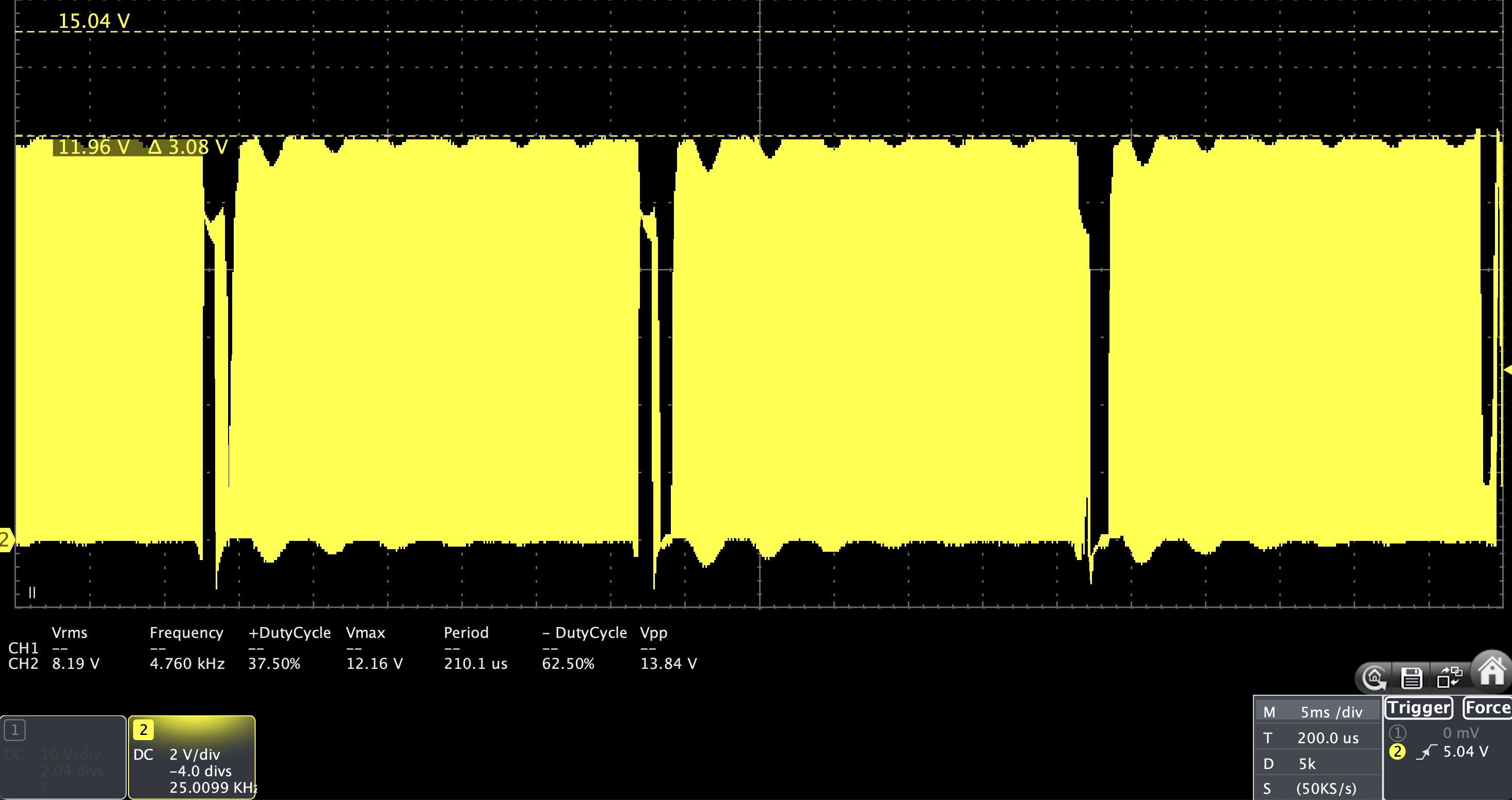
I have updated the code as you suggested. motor.voltage\_limit = 1.0
and the driver voltage to 12.0. This is the osilloscope image. It does not spin still. I have ordered AS5600 btw. I did not research deeply, but i will try to implement it for my motor. However, firstly i need to spin that motor w/o a sensor. So, i need your help about it sir.